
Connect to the Network and Audio/Video Sources
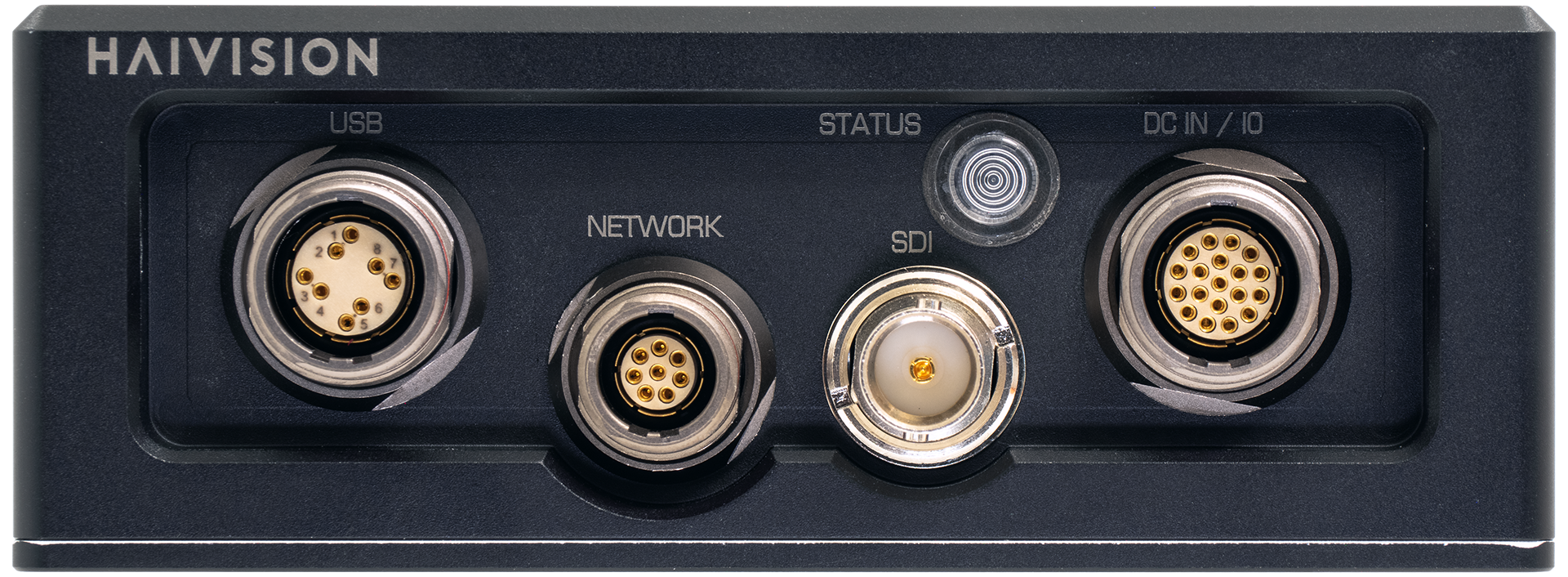
The KX1's rugged enclosure provides the following rugged connectors:
Power (DC) IN & I/O connector combining these inputs:
Power – 30W, 28V DC input (per MIL-STD-704).
Analog Audio – Two (2) channels of analog audio, 33 Kohms input impedance.
Serial Port (RS-232) – can be used for card management, Pass-thru or KLV or CoT metadata ingest.
Force Recovery and System Reset buttons.
Network connector – 10/100/1000 Base-T Gigabit Ethernet; connector also includes a Reset line.
SDI (Serial Digital Interface) connector – 75 Ω BNC (used for either SD-SDI, or HD-SDI video input signals, with format auto-detected).
USB connector – USB 2.0 and 3.2 are supported with a max bandwidth of 10Gbps and a max cable length of 6 feet.
The BNC connector is also a 3G-SDI capable interface supporting 1080p 50/60 fps video @ 3Gbps. In addition, it supports auto-detection of the HD resolution and embedded digital audio.
The Network (ethernet) and Power (DC) IN & I/O breakout cables (shown in the following steps) are shipped as part of the Evaluation Kit.
To connect to the network and A/V sources:
Remove the protective caps from the connectors.
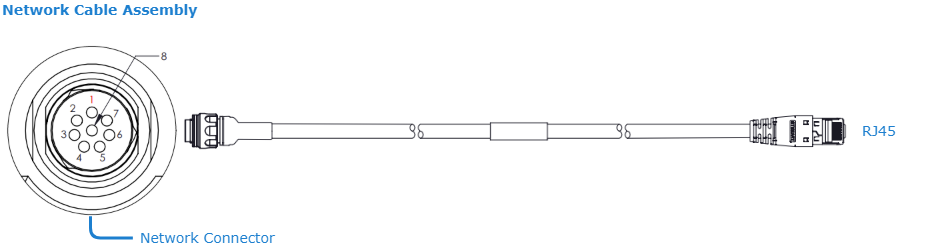
Connect the Network port to the IP network using the Network (ethernet) cable assembly.
Connect the transcoder's SDI video input to your video source.
(Optional) Connect the transcoder’s USB input to your USB source. The USB connector is used, optionally, to flash the Jetson module onto your KX1 hardware, for details see the USB Connector page.
(Optional) Connect the transcoder's Power (DC) IN & I/O port to your audio source(s) using the Power (DC) IN and I/O breakout cable (shown following).
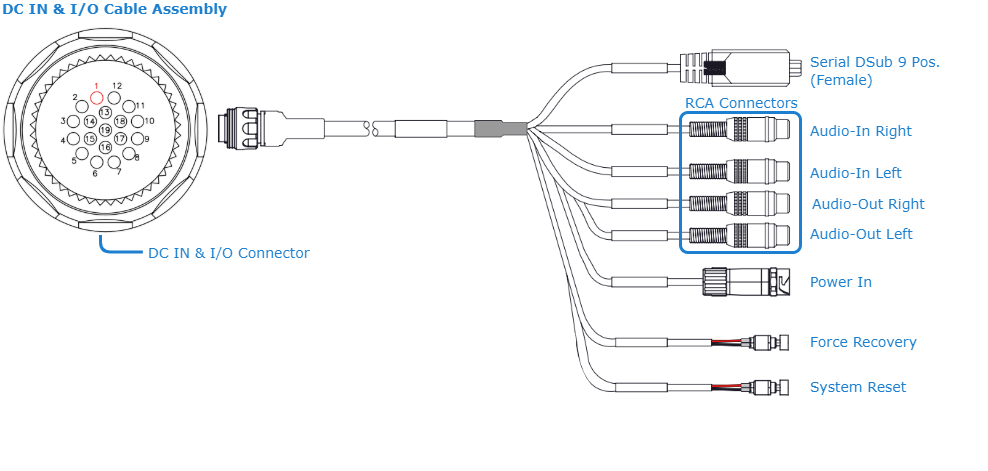
(Optional) If you have a KLV or CoT source that uses RS-232, connect the encoder’s DC IN & I/O port to the metadata source or to the serial port of a computer using the DC IN and I/O breakout cable.
The Power (DC) IN & I/O port may be used to ingest KLV/CoT, as a management port or as pass-thru for camera control.

Note
The Reset button provides two options:
If you press and hold the button for less than 4 seconds, the system resets and loads the last saved "startup" configuration. If no configuration was previously saved as the startup preset, the default settings prevail.
If you press and hold the button for more than 4 seconds, the module performs a complete factory reset. It clears all of the previously configured settings, including IP, streams and encoder configurations.
(Optional) To capture analog audio, connect the transcoder’s Power (DC) IN and I/O connector to your audio source(s) using the the Power (DC) IN and I/O breakout cable, shown in the previous step.
Related Topics: